Showing posts with label Chongqing Local News. Show all posts

Sunday, February 17, 2019

ABB sets up new robotics center in Chongqing


ABB's robotic arms work at a plant in Duenas, Spain, March 27, 2017. The company is famous for its industrial robots. [Photo/VCG]


ABB Group of Switzerland said it plans to enhance its business presence in Chongqing and support the development of the robotics industry in China's western regions, by stepping up smart manufacturing and driving an industrial upgrade.
On May 17, a new ABB robotics application center was set up in Chongqing Liangjiang New Area, a national development zone modeled after Shanghai Pudong and Tianjin Binhai.
ABB's Chongqing center, the fourth one after the centers in Shanghai, Zhuhai in Guangdong province and Qingdao in Shandong province, aims to integrate resources in Southwest China by providing robots, application, system integration and related customer service.
The center will develop robots for its clients from various industries, including automobiles, computers, communications, consumer electronics, equipment and consumer goods manufacturing.
"Chongqing plays a critical role in China's economy, especially in manufacturing," said Li Gang, head of the Robotics and Motion Division at ABB China, at the launch ceremony.
"Chongqing and its neighboring regions provide ABB with a large market for robotics application and I hope this center will help strengthen our relationship with local clients."
China has been the world's largest market for robot applications since 2013, according to data from the International Federation of Robotics.
As the only municipality in western China, the city is one of the country's leading economic centers and a major manufacturing base. It has the country's largest auto manufacturing base and one third of the laptops in the world are made in Chongqing.
Facing a shortage of labor and rising labor costs, China unveiled an ambitious plan in 2016 to triple its annual production of domestic industrial robots to 100,000 in five years.
ABB Group, the Zurich-headquartered industry giant, has been a pioneer promoting robotics applications in China since 1994. In 2015, it started robotics research, development and manufacturing in China.
"ABB's relationship with China dates back to 1907 when it delivered a steam boiler to the country. Today, we continue this relationship with our technology innovation, which has promoted the development of many industries," said GuChunyuan, ABB's president for Asia, Middle East and Africa.
"In the past four decades, ABB has experienced, participated in and benefited from China's reform and opening-up. In the future, we will keep leading technology innovation to better serve Chinese people."


Guoyuan Port launches large-scale logistics transportation

Guoyuan Port launches large-scale logistics transportation
Chongqing Guoyuan container terminal is a water, railway and road combined transport hub port.

Guoyuan Port launches large-scale logistics transportation
The Yangtze River and Silk Road economic belts have brought huge opportunities for Liangjiang New Area (LNA) to establish an inland international logistics hub

Guoyuan Port launches large-scale logistics transportation
In order to reduce pressure on Cuntan Port, a major strategic deployment to separate empty containers to Guoyuan Port was launched.

Recently, a ship loaded with empty containers berthed slowly into the Chongqing Guoyuan container terminal, which is a water, railway and road combined transport hub port. The activity marks the launch of Guoyuan Port in container logistics operation on a larger scale after its opening in December 2013.

The Yangtze River and Silk Road economic belts have brought huge opportunities for Liangjiang New Area (LNA) to establish an inland international logistics hub. As a port where the two belts join together, the interactive development between Guoyuan Port and Cuntan Port invites attention. In order to reduce pressure on Cuntan Port, a major strategic deployment to separate empty containers to Guoyuan Port was launched. Guoyuan Port would gradually become an important hub port.

To ensure the smooth operation of the container, Guoyuan Port overcame many difficulties in the early stage, like insufficient staff and unfinished sites. The separation was secured through five aspects. First, each link and step divided work in an orderly fashion in the production organization. Second, the newly-developed container system withstood tests. Third, staff arrangement could meet the needs of production and operation. Fourth, the port made full use of the yard space and promoted efficiency. Last, the port dispatched all things elaborately and made many plans in case of emergencies. According to Port Logistics Group Guoyuan Container Company, the company and customers have all expressed their satisfaction with the container operation.

Guoyuan Port officially opened in 2014. The port has a shoreline of 2,800 meters and was designed with 16 berths to handle 5,000 tons. Currently, those 16 berths have all been established. The port is accelerating the construction of a railway entering the port and warehouse.

Chongqing’s first cloud computing center starts operation in Liangjiang New Area

Chongqing’s first cloud computing center starts operation in Liangjiang New Area

Pacific Ocean Telecom completed its Pacific Ocean Telecom (Chongqing) Data Center in March, and the initiative is Chongqing's first cloud computing data center project, and is located in the Liangjiang International Cloud Computing Industrial Park, in the Liangjiang New Area of the city.

It is the company's fourth data center in China, after it established centers in Hong Kong, Shenzhen in Guangdong province, and Tianjin.

The construction started in May 2011, and it consists of two parts, with each one covering an area of 20,000 square meters. It was built according to international environmental standards and energy performance standards, uses energy-saving technology, and other advanced technology in refrigerating system and modular design.

Pacific Ocean Telecom is a private enterprise that owns the largest submarine cable network in Asia, and this project means that Chongqing will be part of the company's network.

Chongqing unveiled its development strategy concerning the international off-shore cloud computing industry at the end of 2010, and established a "cloud computing plan" to boost its competitiveness. The construction of the cloud computing data and its supplementary industrial base was a key part of the plan.

Henry Lam, GM of Pacific Ocean Telecom, said that Liangjiang New Area is currently the most popular economic area in China, and it is set to become an important hub of the Chinese mainland in the advanced manufacturing industry, and also in logistics and transportation. He added that the world-class data center will greatly support the industrial and economic growth of China's southwest region.


Trade functional area starts operation in Liangjiang

Trade functional area starts operation in Liangjiang
The new trade functional area began operations in the Chongqing Lianglu Cuntan Bonded Port recently. [Photo/liangjiang.gov.cn]

The Lianglu Cuntan trade functional area passed its national acceptance and commenced operations on April 16, becoming the only functional trade area in China's central and western regions, according to Chongqing Daily.
"The operation of the Lianglu Cuntan trade functional area signifies that Chongqing Bonded Port will take a lead in integrating the foreign and domestic trade markets," said a senior from the Chongqing Lianglu Cuntan Bonded Port.
Taking advantage of policies, the Lianglu Cuntan Bonded Port will develop its trade and finance industries and realize the interaction between trade functional areas and other areas in the bonded port.
According to Xiao Zhongping, vice manager of the Chongqing Bonded Port Development Company, the trade functional area will promote the development of an exhibition commodity trade center and cross-border ecommerce.
The operation of the trade functional area will also benefit enterprises based in the bonded port. "At present, the annual sales volume of our company is around 200 million yuan ($32.30 million) and we will strive to reach 500 million yuan in the future," said a senior staff member from the Chongqing Feiliks Logistics Company. In addition, Feiliks plans to start new business, such as the import and export of machinery and electronic products.
"Liangjiang has to adapt to China's 'new normal' of slower economic growth and promote its functional construction to accelerate the opening-up of Chongqing," said Tang Zongwei, deputy secretary of the Liangjiang administrative committee.
 Edited by Jacob Hooson


Beijing Hyundai gears up manufacturing in Liangjiang

The new plant of Beijing Hyundai Motor Co has been accelerating development of the auto industry in Chongqing's Liangjiang New Area, local media reported on April 25.
Established in July 2017, the company’s Chongqing plant is an advanced smart factory equipped with highly efficient intelligent robots and fully automated production lines.
Beijing Hyundai gears up manufacturing in Liangjiang
Beijing Hyundai's plant in Chongqing's Liangjiang New Area has the most advanced intelligent manufacturing equipment in China. [Photo/liangjiang.gov.cn]
"The debut of Beijing Hyundai Encino on April 10 has provoked strong market demands and our production lines are running full speed ahead," said Li Qihe, deputy director of the company's Chongqing plant.
"The Chongqing plant has fit in the local industrial ecosystem and will add dynamism to the region's industrial restructuring," according to Li.

Beijing Hyundai gears up manufacturing in Liangjiang
Beijing Hyundai's Encino car with high performance [Photo/liangjiang.gov.cn]

Following the dynamic growth of auto manufacturers like Beijing Hyundai, a "goose queue" effect has come into being — 44 upstream and downstream enterprises have landed on branches in Chongqing.
As the engine of Chongqing's auto industry, Liangjiang New Area will promote the brand of "Made in Liangjiang" and attach more emphasis to all-around development.

Changan Ford gears up for NEV market

Changan Ford gears up for NEV market
Ford Fusion Energi Plug-in hybrid car is displayed, with a charging box on the wall, at an exhibition in Shanghai last year. HAO YAN / CHINA DAILY

Sino-US joint venture Changan Ford is entering the new energy vehicle market as it transforms from a traditional carmaker into an auto mobility solution provider, after gaining a foothold in the Chinese market by offering customers a wide variety of models that meet their new demands.

Ford Motors' new energy vehicle strategy means that 10 to 25 percent of its global sales volume should come from NEVs by 2020, and Changan Ford hopes to match this in China.

The carmaker is developing a new energy platform that can be deployed on hybrid electric, plug-in hybrid and fully battery vehicles. The platform allows the NEV models to be tailored so that they conform to the needs and regulations of different markets.

"We are going to keep investing heavily in NEVs," said Marin Burela, president of Changan Ford Automobile Co.

"With the latest platform, we will tailor the models to touch the hearts and minds of Chinese customers," said Burela.

"We need to be leading in technologies, fuel economy and emission, with the right electric strategy and very broad vision," he said.

The C-MAX Energi plug-in hybrid vehicle is set to follow the Mondeo PHEV, which is already in production at the company's Chongqing plant, into the Chinese market.

Against its domestic rivals, Changan Ford has climbed from sixth to fourth in terms of sales volume so far this year. It has achieved a sales volume of 244,000 units in the first quarter, up 23 percent on the same period in 2015.

"We have been continuously focusing on the voice of Chinese customers, and we will never stop doing that," Burela said.

"Just four months after it was launched, the Taurus is already outselling its major rivals. We also have an unparalleled lineup of SUVs. Changan Ford is extremely aggressive when it comes to introducing new cars," he said.

The Chongqing-based carmaker has found from customer feedback that Chinese buyers require connectivity that enables them to work while they commute, and that they also favor a grand-looking exterior.

The carmaker's answer is the Ford Taurus Limited Edition, which makes its Chinese debut at Auto China 2016. The car is designed to be a sophisticated modern mobile office on four wheels. The Sync 3 connectivity function is provided for the first time, and it enables passengers to meet work demands through wireless connectivity.

Work is not the only consideration, though. Passengers may relax in their seat and enjoy a massage and they can also talk to the vehicle. If the driver or passenger says "I need coffee", the car will help them find the nearest cafe, according to the company. In addition to the in-car technologies and ambient configurations, slight changes have been made to the locally produced models to meet the aesthetic requirements of Chinese customers.

Globalfoundries partners with Chinese city Chongqing on chip-making JV

Globalfoundries partners with Chinese city Chongqing on chip-making JV
Two men present new wavers in 300 mm format by semiconductor producer Globalfoundries in Dresden, Germany, June 15, 2012. [Photo/IC]

CHONGQING - US semiconductor manufacturer Globalfoundries said this week that it had entered into a chip-making partnership with the government of Chongqing in southwest China.

The joint venture will utilize systems and processes used in Globalfoundries' Singapore plant to produce 300 mm chips. Production will kick off next year.

Chongqing is one of the world's largest manufacturing bases for computers, smartphones and other electronic devices, providing substantial demand for the joint venture.

"China is the fastest-growing semiconductor market in the world, with more than half of the world's semiconductor demand and a growing ecosystem of fabless companies competing on a global scale," Globalfoundries CEO Sanjay Jha said in a press release.

Semiconductors are one of several high-tech industries the government is increasing support for, as part of a wider effort to steer the vast manufacturing sector away from low-end to high-value added, tech-intensive production.

China has been the world's biggest consumer of semiconductors for years and wants to reduce its reliance of imported chips. Domestic chip designers and foundries have been encouraged to enhance their chip making capabilities through acquisitions or joint ventures with overseas firms.

Chongqing turning into coffee trade powerhouse

Chongqing turning into coffee trade powerhouse

Chongqing, a municipality in southwestern China, might have seemed like an unlikely place for a coffee trade center before the city announced the establishment of the Chongqing Coffee Exchange in June.

But now it hopes to become the world's third-largest coffee futures market, after New York and London.
Its big ambitions ride on an intercontinental railway connecting Chongqing and Germany, the brainchild of local government that began operating in 2011.

Since last year, Yunnan-based coffee producer Hogood Coffee Co has used the 1 1,000-kilometer-long Chongqing-Xinjiang-Europe International Railway for exporting coffee products.

"It not only cuts costs, but also saves time," said Xiong Xiangren, founder of Hogood, which is China's largest instant-coffee producer.

Hogood accounts for about half of China's coffee exports, and its clients include such major brands as Nescafe, Maxwell and Kraft.

The bright prospects for coffee are just part of the picture, however, as Chongqing, a megacity of 30 million people and China's fourth municipality, is rapidly becoming a trading hub for goods bound for Europe. The transformation is in large part due to the China-Europe transcontinental trains.

Statistics from the General Administration of Customs of China show that as of mid-June, 45 percent of goods transported by the Sino-Europe railway began their journey in Chongqing.

In the Chongqing Liangjiang New Area, the rail link and two large Yangtze River ports are connected by highways and railroads, creating a vast logistics network.

The rapid growth of freight transportion on the railway connecting Chongqing and Duisburg, Germany, pushes the inland municipality to the front of China's Europe-bound international trade, according to businesspeople.

"Initially, it was mainly IT hardware in Chongqing shipped abroad through the railway," said Qi Dan, general manager of Yuxinou Rail Logistics Co. "By 2014, almost all major industries here and nearby provinces had direct or indirect access to the railway."

The rail line also is spurring the growth of new industries in Chongqing, Qi added.

Additionally, the city is seeing rapid development in cross-border e-commerce, automobile imports and international logistics. According to China Railway Corp, 16 Chinese cities had joined the Sino-European railway service as of June, with over 1,700 trains operating on a regular basis.


Chongqing a key trade hub between Europe and Southeast Asia

Western China's Chongqing shaping up as key trade hub between Europe and Southeast Asia

A new dimension to the burgeoning trade between China and Europe is the huge volume of goods now being carried overland through Central Asia to the western area of the world's second-largest economy.

The rail link between Chongqing and Duisburg, Germany, which opened in 2015 and can carry goods along the 11,179-kilometer route in 13 days at its fastest, is now a vital artery of China's Belt and Road Initiative.

Greater trade and economic cooperation between Europe and China is therefore key to Premier Li Keqiang's six-day visit to Bulgaria and Germany, which began on July 5.


Chongqing a key trade hub between Europe and Southeast Asia
Chongqing's Cuntan Port in the Liangjiang New Area. Chen Lixing / For China Daily

Chongqing a key trade hub between Europe and Southeast Asia

An aerial view of the Guoyuan Port in Liangjiang New Area, Chongqing. Zhang Jinghui and Wan Nan / For China Daily

In Sofia, Bulgaria, he attended the seventh leaders meeting of China and the countries of Central and Eastern Europe, known as the 16+1.

Trade between the world's second-largest economy and CEE countries increased by 15.9 percent last year to $68 billion, according to China's Ministry of Commerce.

In Berlin, Premier Li and German Chancellor Angela Merkel will co-chair the fifth China-Germany intergovernment consultation.

Trade with Germany, which is China's biggest European economic partner, increased by 11 percent last year to $168 billion.

At the epicenter of some of this increased trade with Europe is Chongqing, the municipality in Southwest China with a population of more than 30 million.

Once seen as being at the wrong end of the mighty Yangtze River, which links the city with Shanghai, it is developing into one of China's most important trade hubs, which is having a regenerative effect on the country's entire western region. In 2017, Chongqing's GDP grew at 9.3 percent, significantly higher than the 6.9 percent nationally.

Not only does Chongqing have road and rail links to Europe through Central Asia, but it is also linked to Southeast Asia through the Southern Transport Corridor, which links Chongqing by rail to Qinzhou Port in the Guangxi Zhuang autonomous region, providing a gateway to Thailand, Vietnam, Malaysia and Singapore.

As a result, Europe also has a land connection now to Southeast Asia, with Chongqing as the vital link.
At the center of all this activity is the Liangjiang New Area, which occupies 1,205 square kilometers in Chongqing. It was the third State-level economic development zone of its kind when created in 2010.

In the meeting room of the new area's headquarters in the Jinshan building on Jinyu Avenue, Li Guang, the 55-year-old vice-president of the Liangjiang New Area Investment Invitation Group, says the European connection is very important now for Chongqing.

"The railway connection has been very important for development here. Goods can be transported in and out of Chongqing, and we have become a logistics hub for goods from the rest of China and also from Southeast Asia to Europe. We are building a new transferring center here to facilitate this. It is all part of the opening-up of the west of China as part of China's Belt and Road Initiative."

Chongqing a key trade hub between Europe and Southeast Asia
Chongqing International Exhibit and Trading Center is located in Chongqing Lianglu-Cuntan Free Trade Port Area. Zeng Yong / For China Daily


The Liangjiang New Area - whose name means two rivers, in reference to Chongqing's location at the convergence of the Yangtze and Jialing rivers - is home to 130 of Chongqing's 250 Fortune Global 500 companies. Last year, it attracted one-third, or $3.3 billion (2.8 billion euros; £2.5 billion), of the city's $10 billion of inward investment.

Li Guang is particularly eager to attract investment from across Europe, including Central and Eastern Europe.

"What we can offer European companies is the sort of market they might not be able to get at home, with the huge local population and also potentially the whole of China," he says.

"We are very open about companies coming in here wanting to form joint ventures or some form of cooperation arrangement. We want to attract top industrial teams to Chongqing," Li says.

Jefferson Wang, head of the Greater China government and economic development practice for management consultants A.T. Kearney, says Chongqing, despite being one of the biggest cities in the world, faces a challenge because it is not well-known internationally.

"It is certainly not as well-known as Guangzhou or a number of other Chinese cities, and I think this holds it back a little. It is a major challenge for the local government to do more to promote itself," he says.

"Belt and Road, however, is a major opportunity, since it is at the center of the west of China and can really open the region as a logistics hub."

Wang says it is important to not just focus on rail, with aviation being equally important. The third terminal of Chongqing Jiangbei International Airport opened in August last year, and the aim is for the airport to become a major international air hub and the biggest airport in western China by 2030.

"Of the 69 international routes at the airport, 44 are linked to countries on China's Belt and Road. There is huge potential here," says Wang.

Logistics are vital for Chongqing, since it has emerged as a major manufacturing center with a significant proportion of China's manufacturing moving westward, away from the eastern seaboard and southern China, where the country's economic transformation began 40 years ago after Deng Xiaoping's reform and opening-up.

Shi Rui, deputy director of the modern service industry department at Chongqing's Liangjiang New Area Investment Invitation Group, says logistics challenges have previously held the city back.

"It has always been very challenging for us. We have a local saying that it is easier to get to heaven than out of Chongqing because of the mountains. So for the past 20 years, Chongqing has invested heavily in logistics infrastructure, developing the airport and establishing railway connections," she says.

This has enabled Chongqing to become the world's largest laptop producer in just over a decade.
In fact, one-third of the world's laptops are made in the municipality with Acer, Asus, Toshiba and Sony all establishing major operations.

"Traditionally, Chongqing has been based on heavy industry, but the gradual switch to light industry such as laptop production has been built on developing the city as a logistical hub," says Li Guang, of the Liangjiang New Area Investment Invitation Group.

"The railway connection to Europe has made it easier to transport laptops there and also easier to establish supply chains."

Edward Tse, founder and chief executive officer of management consultancy Gao Feng Advisory, believes Chongqing is representative of a major global shift as China's Belt and Road evolves.

"We are moving away from the world which was dominated by the maritime powers in the 19th century like Britain, and then after World War II by the United States, to one where the countries that were previously landlocked are emerging," he says.

"Chongqing is almost a starting point for this change, linking China through Central Asia to Europe. It is a very natural revival of this axis of the world that once formed the old silk routes."

One of Chongqing's impressive logistics facilities is Guoyan Port, the largest inland river port of its kind in China, which handles 30 million metric tons of freight a year.

The port was opened in 2008 and now has 16 ship berths, each handling 5,000 tons. On a visit to the site in 2016, President Xi Jinping said the port was "full of promise for the future".

The port handles cars - Chongqing is a major car production center, with Changan Ford having a major manufacturing base in the Liangjiang New Area - as well as coal, ore and mining products.

Containers can be offloaded at the port and transported by rail to Europe. The port is one of the most important on the Yangtze River Economic Belt, with goods making the 2,000-km journey downstream to Shanghai.

It takes from 10 to 17 days to transport goods from Chongqing to Shanghai at a cost of 4,000 yuan ($603; 517 euros; £456) per standard container. This is considerably cheaper than the 16,000 yuan by road, which takes 24 hours, and the 8,000 yuan by rail, which takes three to four days.

"We are very well connected to rail, roads and waterways. It is important to have a multichannel logistics network," says Fang Liang, manager of the port's commercial department.

Liu Wanhong, a director of Minsheng Shipping - one of the biggest users of the port, accounting for 30 percent of its container volume - says the port facility has encouraged many companies to locate in the area.

"One of the most important considerations companies have is about getting goods in and out," he says.


Another logistics facility is the Chongqing Lianglu-Cuntan Free Trade Port Area, which is the only bonded port area in western China. It has been in operation since 2008 and is one of only 14 such areas in the country.

Goods entering the bonded port are deemed not to have entered the country until they leave, when they will be subject to normal customs clearance. Both Chongqing Liangbei International Airport and Cuntan Port are within the bonded zone, which is home to six of the top 10 logistics companies in the world.

"It is very important for Chongqing to have its own bonded zone. We produce a lot of cars and laptops here, and if all these have to go through Shanghai or Shenzhen, it becomes very expensive for manufacturers," says Qu Huang, deputy general manager of the free trade port.

One of the exciting aspects of Chongqing's new connectivity is being able to link Europe to Southeast Asia by rail.

One of the key organizations facilitating this is the Chongqing Connectivity Initiative - whose full name is the China-Singapore (Chongqing) Demonstration Initiative on Strategic Connectivity.

It is the third major intergovernmental initiative formed between China and Singapore. The other two are the China-Singapore Suzhou Industrial Park, which was launched in 1994 and seen as vital to China's early industrial development, and the Sino-Singapore Tianjin Eco-city.

The Chongqing Connectivity Initiative was launched in November 2015 by President Xi and Singapore Prime Minister Lee Hsien Loong with the aim of developing cooperation in financial services, aviation logistics and transportation, and communication and information technology.

Han Baochang, the initiative's director-general, believes there is a real opportunity to build connections between Europe and Singapore.

"Chongqing has a real opportunity to elevate its status into a hub for international logistics," he says in his offices in Chongqing's Jiangbeizui financial district.

He cites the example of a Vietnam manufacturer of high-end sports shoes that might need high-quality plastics from Europe.

"The raw materials can come via rail from Europe to Chongqing and then go through the Southern Transport Corridor to Vietnam. The end product can then be sold across ASEAN countries or Europe, going back by the same route."

Tse at Gao Feng Advisory believes there is a bigger picture to the establishment of greater links between Europe and China.

"There is a danger of seeing this just in terms of rail links. It all becomes a little bit technical if that is the case. It ignores that China now has this overarching view emboldened by Xi Jinping's concept of building a 'common destiny for mankind'. This is not just Europe and China working together, but also countries in Africa, Central Asia, Southeast Asia and elsewhere, too."

Hu Yongqi contributed to this story.

Contact the writers at andrewmoody@chinadaily.com.cn

Saturday, February 16, 2019

Over 12,000 firms set up in Chongqing FTZ in 2018

Over 12,000 firms set up in Chongqing FTZ in 2018
The pilot free trade zone (FTZ) is located in southwest China's Chongqing municipality. [Photo/liangjiang.gov.cn]


A total of 12,768 enterprises were set up in the pilot free trade zone (FTZ) of southwest China's Chongqing municipality in 2018, according to the municipal commission of commerce.

The total registered capital of the newly established enterprises surpassed 128 billion yuan ($18.89 billion).

Chongqing's pilot FTZ has improved its business environment by cutting the approval time for starting a business and projects. Last year, a special court handling cases related to investment, trade, finance, and intellectual property right issues, opened in the FTZ.

The newly-registered enterprises are engaged in artificial intelligence, aerospace, medical service, aircraft maintenance and other industries.

Shanghai's FTZ was China's first pilot FTZ set up in 2013. Since then, China has set up a total of 12 FTZs, with the latest addition being the island province of Hainan, the country's largest FTZ.


Friday, February 15, 2019

DAN Founded China Manufacturing Factory in Chongqing SEZ

Chongqing, June 6, 2017 (PR Newswire) NYSE: DAN held the founding ceremony of the China manufacturing assembly plant in Chongqing, China. The plant covers an area of 7500 square meters (80000 square feet) and will produce advanced powertrain products for the Chinese market.

china manufacturing

The factory that produces the main reducer unit plans to open in late 2018. The characteristic of the plant is the integration of Spicer ® and intelligent interconnection separate all-wheel drive system, which will boost fuel efficiency in SUV, crossovers and passenger cars.

Dana company will invest more than $23 million (about 160 million yuan) to build the new facility and will employ about 130 employees when the factory meets the production goal in 2020.

The factory is located in the industrial special economic zone, Chongqing. The governments and departments of Chongqing have actively promoted and provided full support for this project. This is the 15th factory of Dana in China and the first in Chongqing.

"We are happy to bring the latest all-wheel drive technology to the Chinese market and extend our business to Chongqing for the first time, which reflects our strategic commitment to the Chinese market." Bob Pyle, President of the Dana Group, said, "The reason why we build this new advanced factory in Chongqing is to take advantage of the local skilled labor force, the mature supplier network and the efficient means of transport -- thanks to the vision and support of the local government."

Spicer intelligent interconnection technology which helps global auto makers to respond to the evolving emissions regulations, ensures safety and maneuverability, is currently under the antenatal test stage. 

The Spicer intelligent interconnection system allows the power transmission system to be configured in most driving conditions, enabling it to work in a more fuel-economy front-wheel-drive mode. In case of wheel slide in situations such as speed up or sliding, the system can automatically switch to the all-wheel drive mode.

The introduction of a separate all-wheel drive system into China exemplifies the company's strategy of "driving into the fast lane". Spicer intelligent interconnection system can help customers achieve extraordinary growth in the ever-changing Asia-pacific region. At the same time, the commercialization of new technologies meets the needs of customers and the market for expanding the global market.

It also shows that Dana fully supports the 13th five-year plan and the modernization strategy of the "Made in China 2025", proposed by the ministry of industry and ministry of information technology of the PRC. "Changes in vehicle development make innovation more urgent." Antonio Valencia, President of Dana China, said, "the Spicer intelligent interconnection system is the latest advanced technologies in Dana, which can help the main engine plant in the fast-changing automotive industry to cope with the market trends of the times."

The Spicer intelligent interconnection system for this project has passed the test at the Dana China technology center in Wuxi. As part of global research and development system, Dana China technology center is fully equipped to support the whole process of new product from design to mass production.

Established in 2013, the Dana China technology center has more than 50 engineers. The team is focused on developing new products for China and the Asia-pacific region, and is committed to improving the technology to better meet the needs of the Chinese market. Dana currently has about 6,000 employees in China, including a joint venture of Dana.

Wednesday, February 13, 2019

Smart Airport Launched in Chongqing

By Keqiao Cheng, EDITOR
A smart payment system will be applied in the parking lots of Chongqing Jiangbei International Airport in early August. Furthermore, a number of new cool techs will also show up in this emerging Chinese city.
Such new technologies are expected to bring drastic changes, which is,  for this airport, another important project after the realization of the paperless boarding pass.

Parking is automatically paid, and you can shop later
When you register for the smart payment service, the system will match your car plate with your bank card or Alipay account. Thereafter you will not need cash, bank cards or mobile phone to pay the fees when you leave the garage, and an automatic payment will be made upon departure.
Chongqing Airport is gradually moving towards Smart Airport 2.0 Project, and the new smart payment system can be applied to many other areas aside from just parking lots.
According to a manager at the Chongqing Airport,  parking lots are only the first step. In the future, the smart payment will be applied to the entire airport. Soon, areas such as dining, shopping, and many others will provide customers with the convenience. 
Currently, although there are no technical problems, they are still working on getting businesses connected for the project.
Chongqing Airport
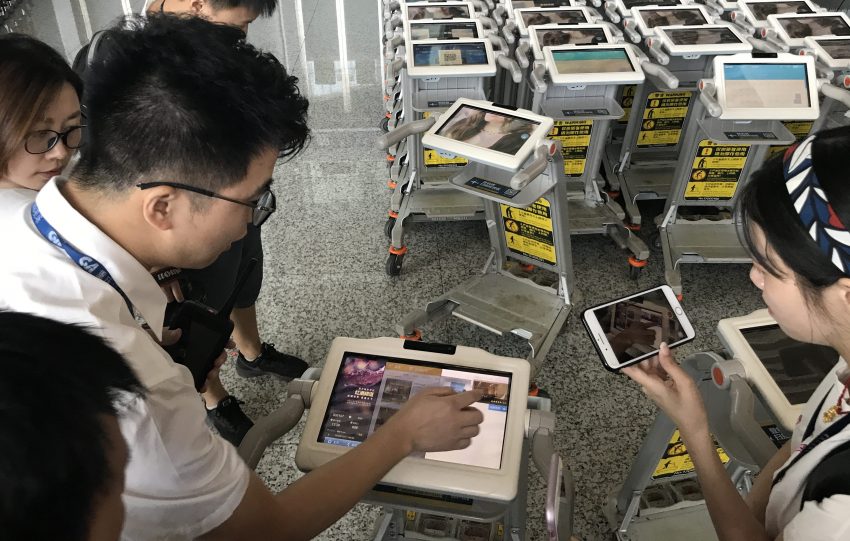
Staff explaining the smart cart system to passengers

Smart carts to show flight information and help passengers navigate through the airport
After passing the security check area, you will find the smart carts. Scanning your boarding pass or typing in flight number will show you the detailed information, including boarding gate, departure time. And the navigation function can take you to anywhere in the airport.
The cart uses IoT (Internet of Things) technology and is equipped with flight information, terminal navigation, mobile phone charging, entertaining videos, and even weather conditions right at your destination. And the best part is, all of these features are free.

No worry about queuing with your E-boarding pass 
Nowadays, passengers can use WeChat or apps to check in, select seats, and obtain electronic boarding passes. With electronic boarding passes, passengers can easily complete the security verification, gate scanning verification and other processes.
After the launch of the paperless-flight project, passengers can now save time, and no longer have to wait in tedious queue lines.
In the past, passengers were often dealing with the problem of losing their boarding passes right before boarding time. Because of these issues, according to a manager at the Chongqing Airport,  the launching of the paperless flight is a key link to provide passengers with efficiency and convenience on each trip.
Chongqing Airport Terminal 3
Travelers are waiting at the baggage reclaim area of Terminal 3

Luggage visualization makes your belongings traceable
The new terminal of Chongqing Jiangbei International Airport has equipped with the luggage visualization system. The screen can show you the clear trace of how is your luggage moved from the aircraft to the baggage reclaim area. This system efficiently alleviates passengers’ anxiety when waiting.

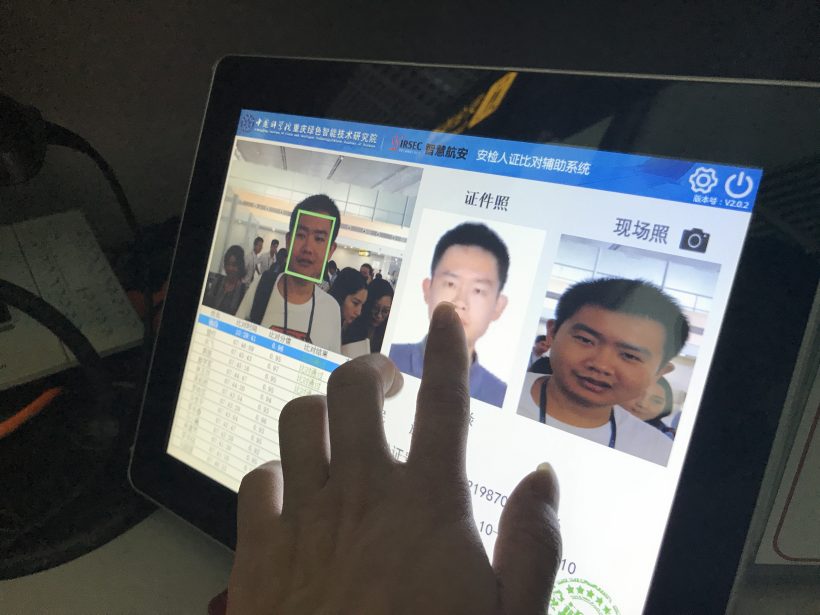
Facial recognition allows passengers to pass through security check within seconds
The system can immediately verify a passenger’s identity when the camera scans his or her face, and it is connected to the police department.
Chongqing Airport
Facial recognition shortens the security check time

Automatic luggage pairing by scanning your boarding pass
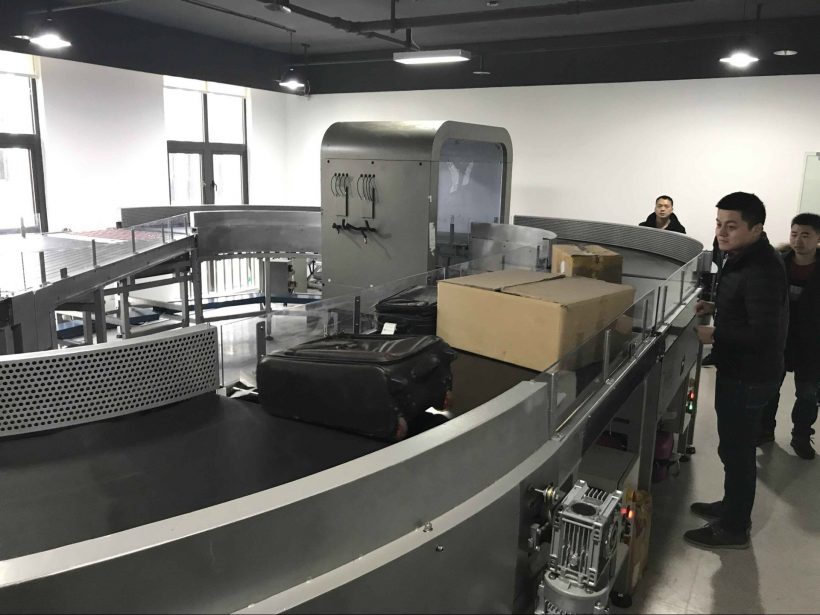
Chongqing Airport has recently introduced a portable baggage pairing system. Without changing the existing layout of the security inspection process, passengers now only need to scan their boarding passes to obtain their luggage, which helps to automatically link together passenger information, carry-on baggage picture information and baggage screening time.
This technology helps to achieve the three-step goal of the carry-on baggage screening process: locating, tracking, and matching, and also provides ease and convenience for security personnel. The on-scene reporter has found out for themselves just how simple this process is. By simply scanning the code on their boarding pass, they experienced the new person-to-bag correspondence.
In addition, Chongqing has also implemented a temporary identity self-service system, which has been up and running in both the T2 and T3 terminals. If passengers have lost, forgot their ID, or are holding a damaged or expired ID card, they can now retrieve a free check-in identity certificate in less than one minute.

International passengers can complete border inspection within 9 seconds
There are currently 15 self-service channels for border inspection at the T3A terminal of the Chongqing Airport. Passengers can go through this self-service process in as little as 9 seconds by swiping their passports (which require a boarding pass before they go through), and then complete fingerprinting and facial recognition.
Self-service border inspection can be completed within 9 seconds, with no need for staff inspection throughout the entire process, which greatly improves efficiency and reduces passenger queue time.
There is also a self-service printer behind the self-service inspection channel. Passengers can print the certificate of their last entry on the printer, free of charge. This entry certificate has the same effect as the Chinese border inspection seal on the entry and exit certificates that are issued by the border inspection authorities.

Source: CQCB.com

Top Robotic Industry Players Settle in Chongqing

Industrial-robot
Industrial robot

By Xiao Wu, EDITOR
According to CQCB, 3 top robotic industry players – KUKA AG from Germany, ABB Group from Switzerland, FANUC Corporation from Japan –have set their branches in Chongqing. Meanwhile, domestic well-known companies including GSK CNC Equipment Co. Ltd., Wuhan Huazhong Numerical Control Co., Ltd (HNC), Googol Technology (HK) Ltd. have also settled here.
Chongqing is the important industrial base in China with output of car, motorcycle and laptop all in the front rank, which makes Chongqing in great need of industrial robot. Besides, there are also increasing demand of industrial robot in chemistry, food, shipping, rail transit, etc. Based on this, robotics industry has become one of the top ten strategic emerging industries in Chongqing with a complete robotic industry chain of assembly, parts production, software development, and follow-up services.
Source: CQCB


Chongqing Pioneers in Big Data Intelligence


Application of Big Data Intelligence in the Operation Center of Chongqing public transport

By Keqiao Cheng, EDITOR
By 2020, Chongqing will convert itself into an important base of intelligent industry in China, and a first-tier pilot city for the application of Big Data Intelligence. According to official documents from Smart China Expo, the crucial goals of Chongqing are as follows.

Intelligent industry
Chongqing will attach importance to developing 12 sectors, including big data, AI, integrated circuit, intelligent super-computing, software service, Internet of Things, automotive electronics, intelligent robot, intelligent hardware, intelligent automated vehicle, intelligent manufacturing, and digital content. It is estimated that the scale of these sectors will approach RMB 750 billion by 2020, and exceed RMB 1 trillion by 2022.

Upgrade the traditional industry
In order to speed the transition of the industries from traditional to intelligent mode, the government will set up 20 intelligent factories, 200 digital workshops and 2000 digital assembly lines by 2020.

Application of Big Data Intelligence
Chongqing will widely apply the Big Data Intelligence in city management, focusing on 5 aspects including integration of industries, government administration, livelihood services, public products and social governance, as well as other 33 fields and 80 crucial intelligent projects.

Innovative system
It is crucial to establish the innovative data-driven system, which includes planning and implementing the research and development of generic technologies, the introducing and developing of innovative platforms for science and technologies, enhancing the research of basic theories and advanced technologies, and speeding up the building of patent pools for intellectual property.

Information infrastructure
To provide a firm support for the development of Big Data in Chongqing, the government will focus on building high-speed, mobile, safe and wide new-type information infrastructure.

Civil-Military Integration
Government will promote the formation of civil-military integration, focusing on strengthening civil-military cooperative innovations, the education of civil-military high-end talents and the structure of civil-military integration platform.

Importing talents
Government will focus on importing high-level talents from all over the world, deepening the reform of educational mode, refining the policy and improving the service for high-level talents.

Five pillars of support for Big Data Intelligence
With the fast and stable economic growth, five pillars of support of Big Data Intelligence have shown up as follows:

I.Positive development of intelligent industry
By 2017, there were more than 3000 enterprises of intelligent industry and the output of intelligent terminals ranked second in China.

II.Sophisticated layout of platforms
The platforms of Chongqing include Liangjiang New Area, 3 bonded areas, 5 high-tech zones and 41 city-level development zones.

III.Improvement of information infrastructure
Chongqing, as one of the 13 national-level crucial Internet hubs in China, has achieved the full cover of optical fiber cable and 4G signals in the whole municipality.

IV.Thoroughly boost applications of Big Data
Chongqing is currently ranked 12th in China, and 2nd in western China, according to an information-based development index. Due to the intelligent application in more and more fields such as public safety, society governance, education, etc., it ranked 7th in 324 cities nationwide.

V.Breakdown in crucial technologies
The facial recognition tech, researched by Cloudwalk, has been widely used in airports all over China. The 8/12-inch semiconductor silicon wafer, researched and produced by Chongqing Advanced Silicon Technology, has been the first Chinese company which has achieved it. 

Source: CQCB